This is how we break the ice!
We avoid the "small talk" hell—prioritizing networking and professional knowledge sharing instead.
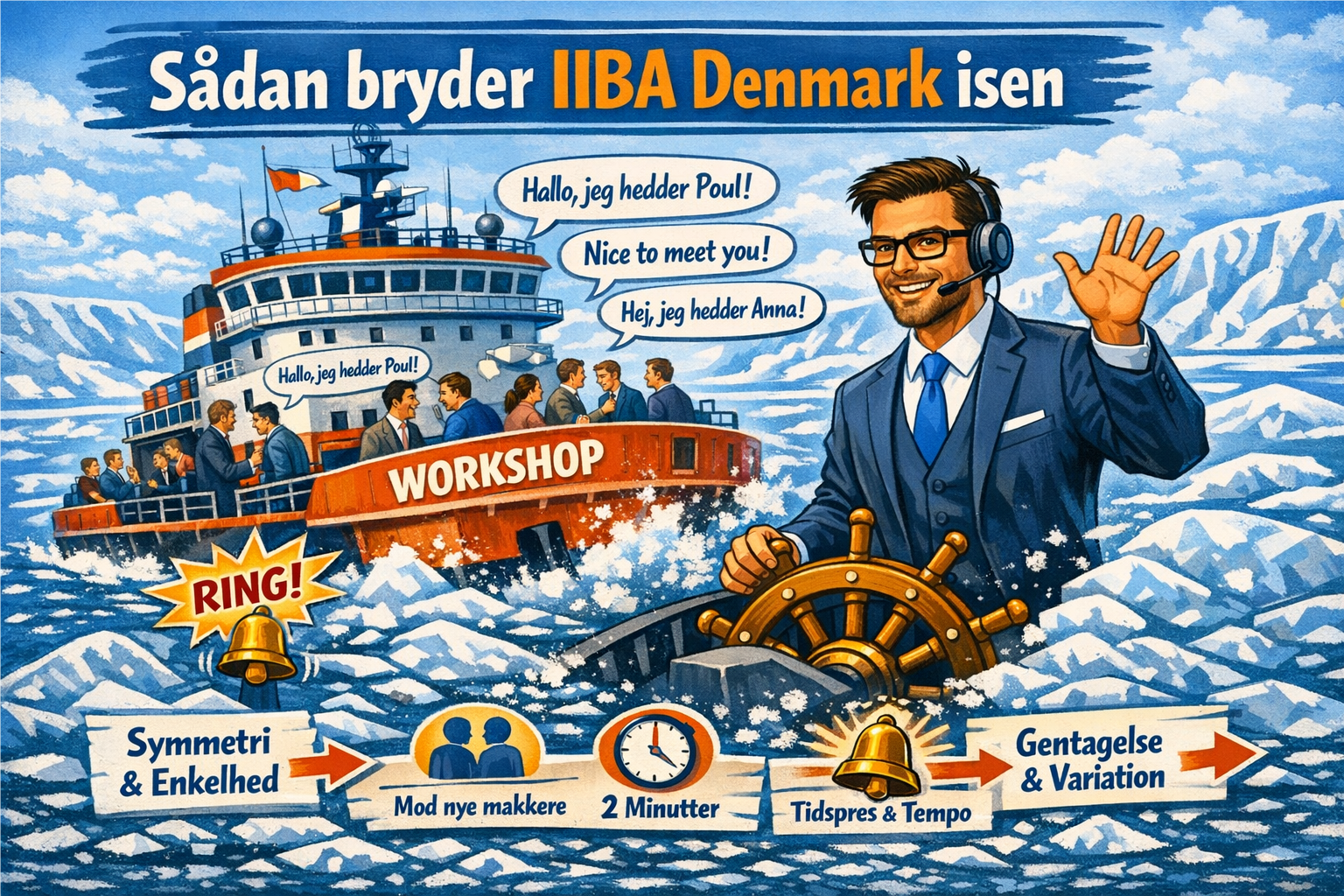
At IIBA Denmark Chapter events, we often use the same icebreaker. It’s a key part of setting the right scene for networking and strengthening our professional community. During the exercise, all participants greet three other attendees they haven’t met before. Below, we explain in detail how you can facilitate this icebreaker yourself and share its origins.
The icebreaker aims to:
- Get participants talking quickly with new people
- Create energy and movement in the room
- Practice active listening and curiosity
- Ensure everyone speaks with multiple different people in a short time
The icebreaker is built on three simple principles:
- Symmetry and simplicity: Clear rules (e.g., short/long hair) eliminate uncertainty about who starts.
- Time pressure creates energy: Short rounds (2 minutes) keep the pace high and conversations focused.
- Repetition with variation: Multiple rounds with new pairings provide both comfort and dynamism.
Background
The exercise was introduced to us by Christina Elise Olesen, an experienced business analyst and application manager. Here, she answers questions about how the icebreaker came to be.
Where did the idea for the icebreaker come from?
“The exercise is a compilation of my own experiences. Its essence comes from my time as a tutor at the University of Copenhagen, where we constantly tried to find new ways to bring new students together. The traditional name rounds and ‘find an animal starting with your initial’—most people have been through those since the dawn of time. We borrowed the time aspect and guiding questions from speed dating and called it ‘speed-friending.’”
Where did the very specific instructions come from?
“They emerged from various experiences I’ve had with group exercises, where I picked up small elements that worked well for different reasons. The idea that someone has shorter hair than others is both a way to avoid the question ‘who starts?’ and a way to activate the sense of sight in the interaction. You can easily adjust these small steps to whatever you find appropriate or fun.”
Why are the instructions so important?
“I’ve noticed that we—especially us Danes—often only start talking to strangers once a shared context is established.”
She laughs and calls it “small-talk hell”: “Or maybe we’ve just lost the ability to create that context ourselves. Children, after all, have a wonderful ability to just start talking—and suddenly, they have new friends. The instructions help ensure the most important part of the exercise: breaking down barriers and creating a shared context so that conversation can actually happen.”
Facilitation Guide
Here’s a detailed walkthrough of how to facilitate the icebreaker yourself.
Setting the Stage Before You Begin
As the facilitator, do the following:
- Ask participants to stand up and spread out in the room.
- Explain that the exercise consists of 3 rounds, each lasting 2 minutes.
- Let them know a bell (or a clear signal) will indicate when a round is over.
- Emphasize that the exercise is informal and about making connections—not about “correct” answers.
- Each participant takes a slip of paper with a question on it.
Round 1
- Ask participants to turn to someone nearby.
- They should establish eye contact—this person is their partner for the round.
- The person with the shortest hair speaks first: “Hi, my name is [their name].”
- The other person responds: “Nice to meet you, [name]. My name is [their name].”
- The person with the longest hair asks the first question (the one on their slip).
- After the first person answers, they switch roles, and the other asks their question.
- When the 2 minutes are up, ring the bell.
- Participants swap their slips of paper.
- They thank each other for the conversation.
Rounds 2 and 3
Preparation
As the facilitator, you need to prepare a set of questions. Below is an AI-generated prompt based on the guidelines. Simply fill in the relevant details for your situation.
Here’s the prompt:
You are a facilitator assistant.
I need to facilitate an icebreaker where participants engage in short, 2-minute conversations.
The questions should create energy, connection, and reflection—without being too personal or overly complex.
Context:
- Work-related setting: [Insert, e.g., workshop, strategy seminar, onboarding, cross-disciplinary meeting]
- Participants: [Insert, e.g., managers, specialists, mixed expertise, new team]
- Theme of the day (if applicable): [Insert theme or write “none”]
Requirements for the questions:
- Should be answerable in 30–60 seconds
- Must be open-ended and curious
- Should work between colleagues who don’t know each other well
- Avoid private or sensitive topics
- Focus on experiences, perspectives, or expectations—not performance
Generate:
- [Insert number] short icebreaker questions
- Optionally grouped into 2–3 categories (e.g., “connection,” “work,” “forward-looking”)
- Written in clear, conversational language
Write in English and in a professional yet informal tone.
How Was Generative AI Used for This Text?
As evident in the text, generative AI was used to create the image and the accompanying prompt. Additionally, AI was also used to draft the instruction itself based on Christina’s presentation from one of our events. It was also used to draft the translation of the text from Danish to English.