Business Analysis in Numbers: What Do Danish Companies Expect?
Despite wide variation—the classic business analyst works with needs and requirements in broad collaboration.
Earlier, we conducted an analysis of posted job listings for business analysts on LinkedIn. Building on this, I’ve dug a little deeper into the content to understand how the role is defined in Denmark and to get a sense of how business analysis is discussed. The primary question is: How is business analysis practiced in Denmark?
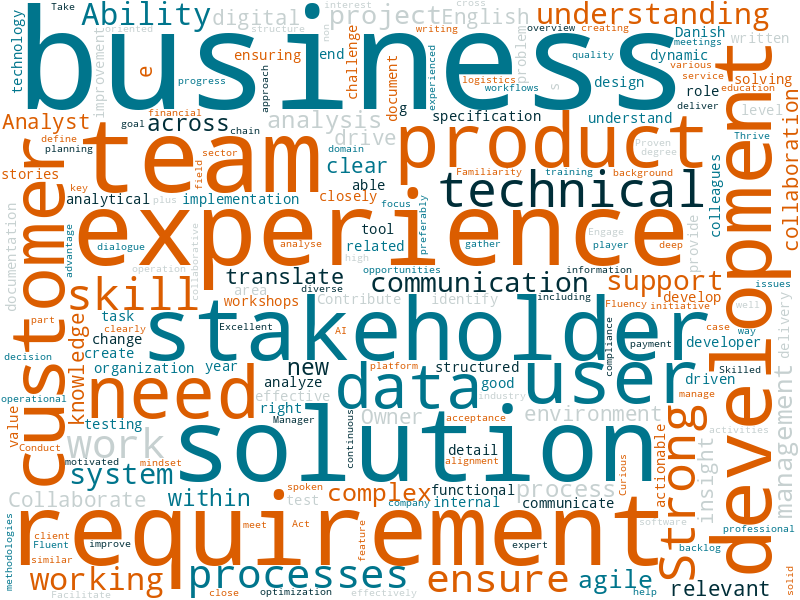
To answer this, I analyzed the content of the job postings using generative AI. Here’s what the content of 58 job listings for business analysts looks like as a word cloud:
Prompt to AI about the content of the job listings
Work with stakeholders, product owners, and users to gather and collect business and technical requirements.
Perform analysis to clarify, validate, and refine requirements so they align with business needs and technical feasibility.
Create clear requirement specifications, user stories, and supporting documentation for development teams.
Convert business needs into actionable technical requirements or user stories that developers can implement.
Communicate, prioritize, and coordinate requirements throughout the development cycle, ensuring alignment and clarifications during implementation.
Examine proposed solutions, create and execute test cases, perform user acceptance testing, validate with end users, and report issues.
Help evolve and design solutions, standardize and simplify processes, challenge existing solutions, and define future states.
Use analysis to drive insights, define solution direction, and deliver recommendations that ensure scalability, simplicity, and operational excellence.
Convert business needs into specifications, clear user stories, and acceptance criteria so development teams can build high-quality solutions.
Act as the link between stakeholders and technical teams, coordinate communication, prioritize work, and support smooth implementation and rollout.
From Practice to Theory...
To gain a broader perspective, I compared the content of the job listings with IIBA’s standard for business analysis. The Guide to the Business Analysis Body of Knowledge (BABOK) includes six knowledge areas that cover all tasks within the field.
These are the core knowledge areas:
- Strategy Analysis
- Requirements Analysis and Design Definition
- Solution Evaluation
These knowledge areas support the other three:
- Business Analysis Planning and Monitoring
- Elicitation and Collaboration
- Requirements Lifecycle Management
Additionally, BABOK defines six fundamental competencies:
- Communication Skills
- Analytical Thinking and Problem Solving
- Business Knowledge
- Behavioral Characteristics
- Interaction Skills
- Tools and technology
The analysis shows that nearly all business analysts are expected to work within Elicitation and Collaboration and Requirements Analysis and Design Definition. Many job listings include both of these areas, while very few omit them entirely—perhaps because they are considered so fundamental that they are taken for granted and not explicitly mentioned. Just over 30% of candidates are expected to contribute to Strategy Analysis.
Regarding the three supporting knowledge areas, only about one-third of job listings include one or more of them. However, it appears that some tasks categorized under Business Analysis Planning and Monitoring are unclear—for example, whether they pertain to planning the analysis itself or the team’s work.
The content categorized under the fundamental competencies is more extensive, particularly in communication skills (65%) and analytical thinking (45%). Under analytical thinking, supporting decisions with data is also included. Just over 30% of job listings expect candidates to possess business knowledge.
...and back again
60% of the job listings specifically mention the use of agile methods, which is further supported by the fact that user stories and acceptance criteria are the most frequently mentioned techniques for describing requirements. A significant number of job listings also demand competencies beyond those covered by the Guide to the Business Analysis Body of Knowledge (BABOK). Primarily, testing skills are in demand, but also implementation (though it is often unclear whether this refers to technical or organizational implementation) and project management.
Overall, there is variation in how the role is defined across different companies. However, despite the wide diversity in responsibilities, tasks, and expected qualifications for business analysts, there is still a common core that nearly all of us share: gathering, analyzing, and structuring information into needs and requirements in collaboration with stakeholders and colleagues.
This broad variation means there are many entry points into the profession. It also offers the opportunity to shape the role yourself and to influence practice in a direction where we use theory to work even more systematically with business analysis.
And remember: A job listing is not a definitive answer key—it’s a wish list!
How was generative AI used for this text?